


If you’ve been asking yourself “why my marketing is not working,” you’re not alone.
Most entrepreneurs are not inactive. They are doing the work. They publish, test ideas, show up, try to stay visible.
And yet, nothing really builds.
Not because the effort is missing. But because the effort doesn’t connect.
Today, your marketing is not experienced step by step. It is experienced all at once, across platforms, formats, and moments of attention.
So when your actions are not clear, not aligned, and not designed to reinforce each other, they don’t accumulate.
They disappear.
And over time, what should feel like progress starts to feel like constant effort.
Tools, including artificial intelligence, can support your marketing.
But they cannot replace clarity, direction, and structure, the elements that make marketing actually work.
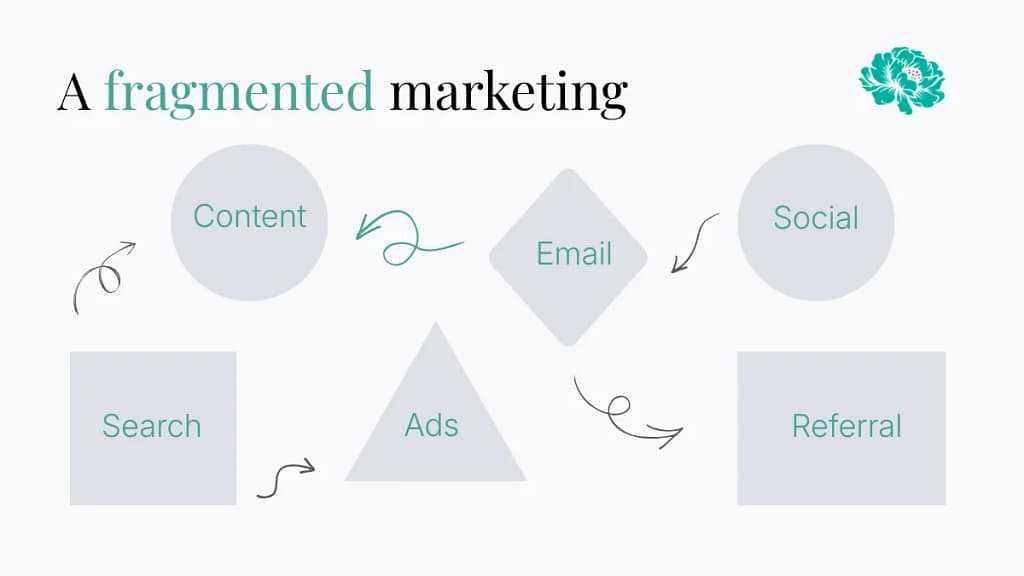
The uncomfortable truth: marketing doesn’t fail randomly
Some seem to think that marketing results are unpredictable. That is not the case. What looks like inconsistency is usually the result of:
- Unclear positioning
- Fragmented actions
- Lack of continuity
Consumer behaviour has profoundly changed. According to research on the new consumer decision-making process, people no longer follow a linear journey. Instead, they move between streaming, scrolling, searching, and shopping (referred to as the 4S), often within the same session.
This shift is even more pronounced in B2B environments. Research from Apollo on the B2B buyer journey shows that decision-making is no longer sequential, but distributed across multiple stakeholders and touchpoints.
This actually means that your marketing is no longer experienced step by step. It is experienced as a system. If your actions are not connected, consistent, and clear across all customer touchpoints your audience may see you, but will not move forward with you.
This perspective aligns with the marketing strategists Kenneth Simon highlights in his analysis of why small business marketing often fails. He points out that the core issue is rarely the lack of tools or effort, but a lack of structured thinking and coherence over time.
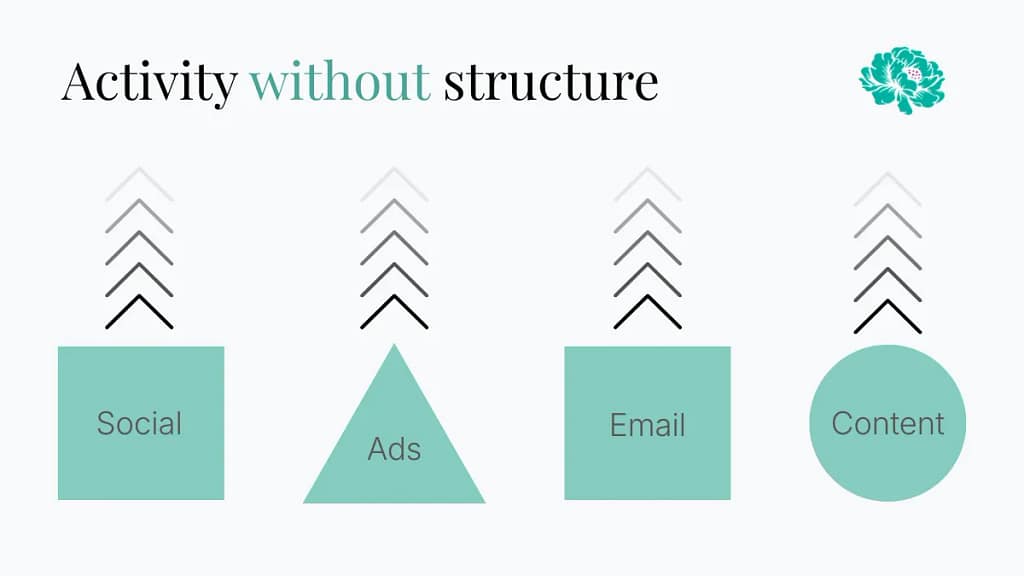
Why your marketing feels active but not effective
You are producing actions in a system that doesn’t exist
Most entrepreneurs don’t lack effort. They produce content, posts, ideas, and many different actions. But all these actions are not inside a system. They are sometimes isolated, or not sufficiently connected with one another.
At the same time, your audience, whether individual consumers or B2B decision-makers, is there streaming content, scrolling passively, searching actively and shopping opportunistically. Moving across multiple touchpoints fast, often even as a part of a broader internal decision process.
So if your marketing is not designed to exist across these behaviours, your actions don’t accumulate, they disappear.
This is why it feels like you are doing a lot, without building anything.
Your positioning is not strong enough to survive fragmentation
Today, people don’t discover you in a single moment. They get to know you, your products or services through fragments.
Those fragments can take many forms:
- a social media post,
- a search result,
- a recommendation or a mention,
- a piece of content they read, watch, or listen to
In B2B contexts, these interactions often happen across multiple stakeholders and over time. In B2C, they may happen faster, but the logic remains the same.
Each of these moments must stand on its own, while still connecting to the others, like pieces of a puzzle that gradually form a clear picture.
If your positioning is not immediately clear, it doesn’t anchor, it doesn’t repeat, it doesn’t compound. And every interaction starts from scratch. This is why your marketing feels like it requires constant effort, as if you are saying the right things, but they are not fully landing.
Because your message, on its own, is not the objective. It is what allows your audience to understand, remember, and eventually choose you.
You are visible in multiple places, but coherent nowhere
Nowadays, visibility is easier than ever. You can publish a social media post in minutes, write an article with the help of artificial intelligence, and show up across multiple platforms with relatively little friction.
But what we often underestimate is the environment in which this visibility happens. It happens in scrolling environments, with short attention windows, and constant competing signals.
So showing up is no longer enough. What matters now is whether your presence connects with your audience. If your message is not consistent, recognizable, anchored, then every interaction becomes a standalone touchpoint.
And this is where momentum breaks. Momentum in marketing is not created by a single action. It is created when multiple interactions reinforce each other over time. It is when your audience starts to recognize you, understands you faster, and move forward with less hesitation.
Without consistency and an overall system, these interactions never connect. They don’t build familiarity, they don’t build trust, and they don’t reduce friction either. And when nothing connects, nothing accumulates.
What actually makes marketing work (in practice)
Marketing doesn’t start working when you do more. It starts working when your actions begin to connect, reinforce, and repeat across how people actually behave today.
In a fragmented environment, where people are simultaneously streaming, scrolling, searching, and shopping, effectiveness is no longer driven by isolated actions. It is driven by coherence over time.
We came up with a 3-step approach actionable for small businesses, solopreneurs, artists, freelancers, and business owners. I used a marketing guide prepared by Salesforce to help small businesses. So here it is:
1. Clarity, your message must survive context
As I said before, your audience doesn’t just discover your business once. They encounter your business through fragments (a search result on Google, a LinkedIn post, etc. …). Each of these moments must stand out on its own.
One of the main challenges small businesses, entrepreneurs face is consistency. Making sure they are understood consistently across all audience touchpoints.
So clarity is not about simplifying your message. It is actually about making it recognizable wherever it appears. In real life, this means that through a single entry point, whether is a LinkedIn post, a Facebook Reel, a Google search result, or a referral, people should understand rapidly who you help, what problem you solve, and what makes your approach different. And all that, without needing any additional context.
Clarity creates value for your business by helping your audience recognize you faster, understand you with less effort, and each interaction reinforces the previous one. And this is what allows your marketing to start compounding.
2. Focus, attention is fragmented, your strategy cannot be
Now marketing rewards presence. But it punishes dispersion. Many small businesses try to be active on multiple platforms, test multiple formats, follow multiple trends. The result is predictable: diluted effort, inconsistent goals, no real traction.
The small business marketing guide prepared by Salesforce highlights that the key relies on prioritization and channel alignment, not omnipresence. Your goal is not to be everywhere, it is to be relevant where it actually matters.
Focus is not about doing less for the sake of it. It is about making deliberate choices on where to show up, how to show up, and what you consistently communicate. Because in a fragmented environment, attention is very limited. And only attention can turn into trust when it is repeated.
One of my former managers used to say that “stuck record marketing” is often the most effective. The idea is simple: if your message changes constantly, it never has the chance to settle. Whereas if it repeats, it starts to become familiar, recognizable and trusted by your audience.
In a world where, on a typical day, a North American is exposed to thousands of ads, often estimated at over 4,000, repetition is not a weakness. It is what allows your message to exist long enough to be understood.
Focus, combined with clarity, makes your message easier to recognize, reinforces your value proposition, and creates a virtuous cycle where your actions support one another. And that is what leads to traction.
3. Repeatable, consistency is the real growth engine
Most marketing efforts fail for one simple reason: they are not designed to last. They rely on motivation, time availability, short bursts of energy. Rather than on a system that can operate consistently over time.
Research from HubSpot’s marketing team shows that brands that maintain coherent messaging and regular presence across channels outperform those relying on sporadic activity. (see https://blog.hubspot.com/marketing/small-business-marketing-guide)
But consistency is often misunderstood. It is not about doing more. It is not about posting more frequently. It is about building a way of working that you can sustain.
What repeatable actually means is that your marketing does not depend on your motivation on a given day, or that your marketing does not collapse when your schedule becomes busy, and of course does not require constant reinvention. It creates stability in how your marketing operates.
Repeatability creates a marketing with actions that are easier to execute, decisions that require less effort, and a presence that becomes more stable. And over time: consistency stops being something you try to maintain and becomes something your system supports.
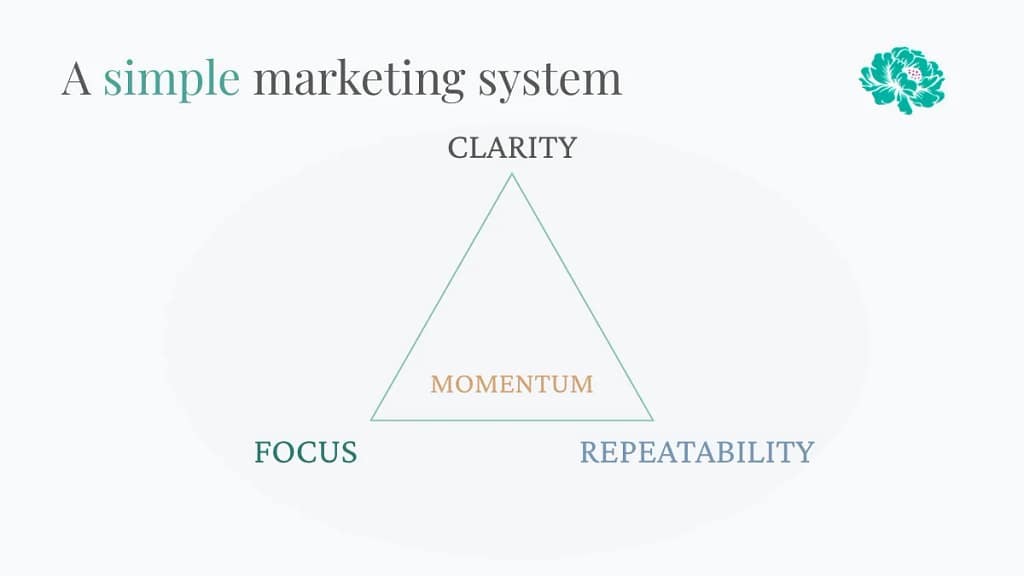
Bringing it together
When these three elements work together, marketing stops feeling like a series of disconnected efforts.
It becomes a system. You can think of it simply:
- Clarity ensures your message is understood
- Focus ensures your message is seen in the right places
- Repeatability ensures your message is sustained over time
Individually, each of these elements creates value. But it is their combination that creates momentum.
- Clarity without focus creates noise
- Focus without repeatability creates inconsistency
- Repeatability without clarity creates confusion
When all three are aligned: your message becomes recognizable, your presence becomes consistent, your actions begin to reinforce each other, and this is where marketing starts to compound.
If this reflects where you are right now, you don’t need more tactics, you need clarity.
You can take a look at how I work and think about marketing.
Published by
Ciro Jaen Paniza – Brand Strategist and Marketing Expert
ciro-jaenpaniza.com